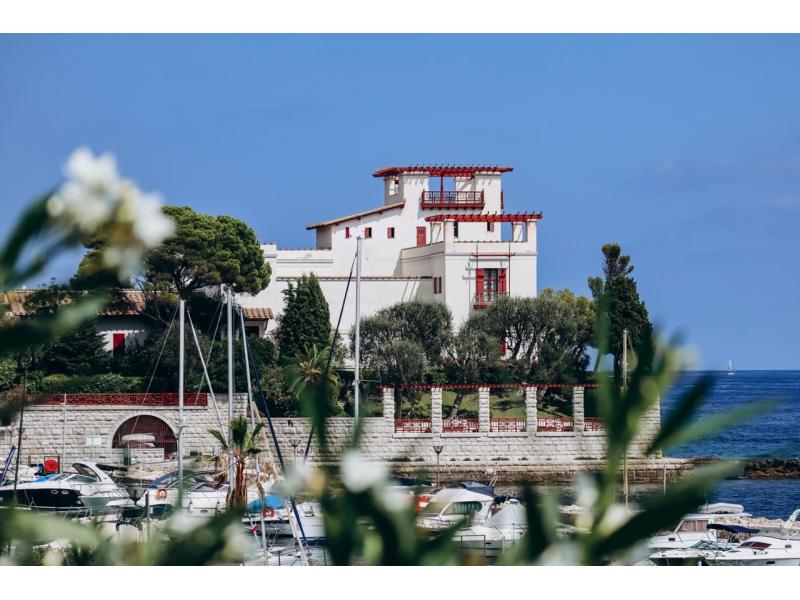
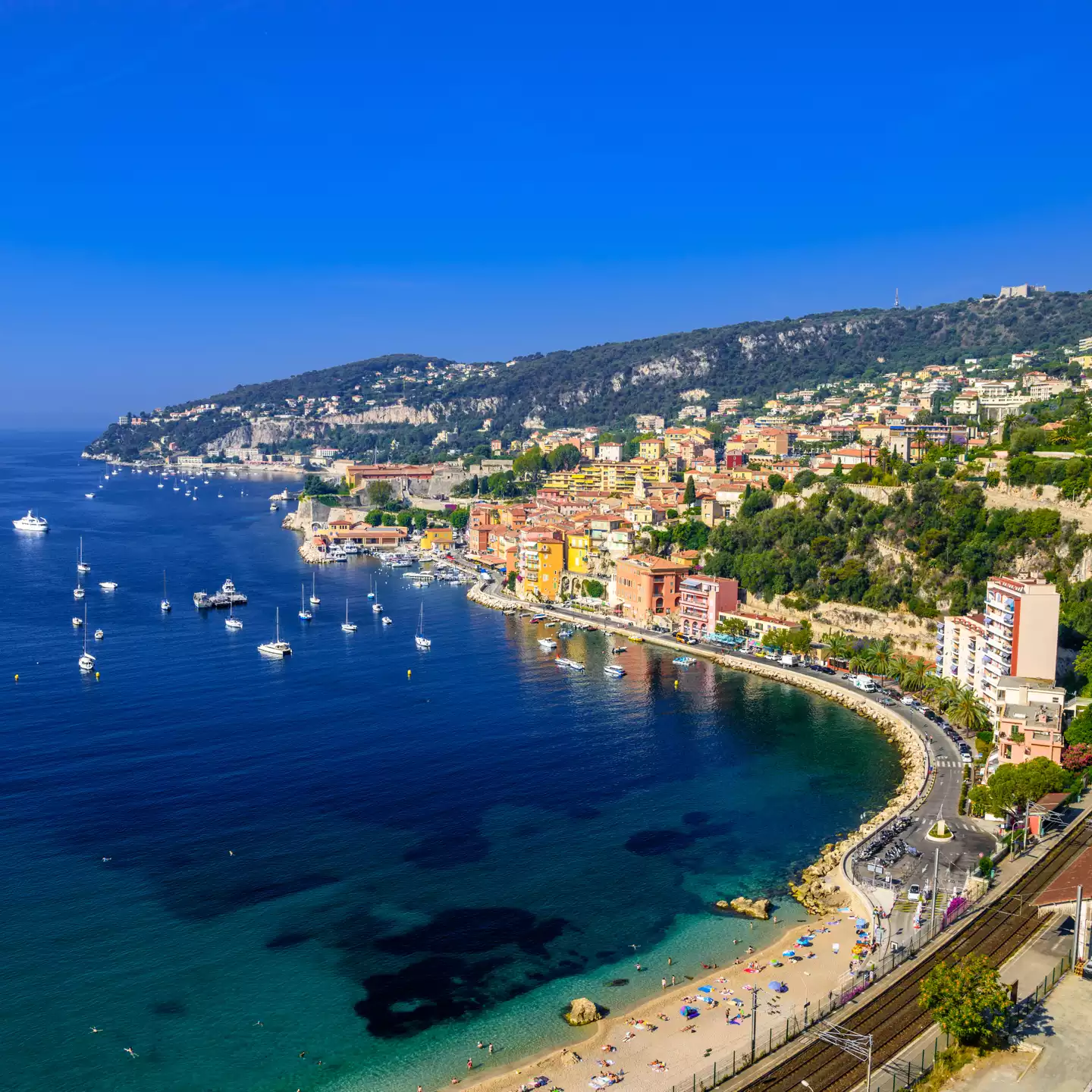
Now a jewel in the architectural heritage of the Institut de France, inherited from Théodore Reinach in 1928, the century-old villa creates the illusion of an ancestral home while offering the comforts of the 20th century. It stands as an allegory of a way of life inspired by ancient Greece, reflected even in its setting: the enveloping light, the caress of the Mediterranean, and the relief of the horizon constantly evoke the radiant beauty of the Greek coastline.
Visiting Villa Kerylos: a journey through history and mythology
“Rejoice”—the Greek inscription xaire—welcomes visitors at the entrance to this vast two-story residence, where every aspect of daily life was conceived by Emmanuel Pontremoli to harmonize with an ancient Greek setting.
The villa houses numerous statues representing major mythological figures such as Heracles and Dionysus, and is adorned with murals painted at the beginning of the 20th century depicting legendary scenes. The most remarkable ensemble is found in the peristyle, illustrating episodes such as the contest of the lyre between Apollo and Hermes, the death of Talos, Apollo’s return to the sanctuary of Delphi, Hephaestus’ return to Olympus, Pelops and Hippodamia, and preparations for the sacrifice of the bull.
The ceilings are decorated with geometric motifs, while mosaics—symbols of wealth in ancient Delos—cover the floors, offering a rich inventory of decorative styles from antiquity. Some also depict famous legends, including the labyrinth in which Theseus slays the Minotaur.
Furniture designed to blend seamlessly into each room
One of Villa Kerylos’s defining features lies in the subtle balance between spaces that evoke the art of living more than 25 centuries ago and furniture adapted to early 20th-century comfort. Bookcases, wardrobes, and fittings were all designed to integrate naturally into each room.
On the ground floor, a succession of spaces evokes rituals of bathing—with the luxurious pool of the Balaneion—as well as mythology in the atrium, banquets, poetry, music, and the arts.
The upper floor houses the private apartments of Théodore Reinach, including a Pompeian red room dedicated to Eros, the god of love. The bathrooms rival one another in ingenuity, featuring innovative systems such as the astonishing open-air shower—reproduced from an ancient model—allowing occupants to bathe in collected rainwater.
The gardens of Villa Kerylos
From the shores of the Mediterranean to the Aegean Sea, such are the imaginary journeys that await visitors strolling through the gardens of Villa Kerylos—a fragrant Eden of Mediterranean species bordered by the Baie des Fourmis and the Gulf of Saint-Hospice.
Echoing the philosophy of the villa, the gardens are filled with scents that evoke the atmosphere of ancient Greece. Visitors wander among olive trees, cypresses, palm trees, and papyrus, accompanied—much as in antiquity—by vibrant oleanders, irises, and myrtles.
The gardens unfold like a path leading to the Gallery of Antiques, where a collection of sculptures pays tribute to Greek mythology.
For more information: official website
Historic villa on the French Riviera